Confession #2
I've had to start underlining in my Barth readings...To add insult to injury, I've had to make marginal notations.
Confession 2.1
This post comes almost one week late. Verzeih mir, Karl.
Just like you will see in the forth coming post on Wright, Barth outlines his epistemological method here in section 2 (I.1 §2). Barth is quite happy in his method being one that is quite succinct. Recalling the theologians of early and medieval church: "It must be remembered that the great representatives of early and medieval dogmatics were sometimes content with the briefest reflections on the way of knowledge taken by them" (p. 25). In this section, Barth will examine and find wanting the epistemological methods of Roman Catholicism and liberal Protestantism advocating an Evangelical approach. (Note: this should not be confused with American, twenty-first century Evangelicalism.)
I once had a professor call Karl Barth a "quasi-good guy." And from the perspective of this professor, I am sure it had something to do with Barth's appeal against dogmatics to answer the questions of contemporary society (i.e. apologetically). Barth says that such notions should be disregarded for three reasons (p. 28-9). Reason one, times have not changed that significantly to to where secularism has rendered dogmatics useless. Number 2, in addressing number one, we leave dogmatics completely and enter an entirely different field. Lastly, if we achieve an apologetically safe dogmatics, faith, essentially, becomes no longer necessary (p. 30). The folly of apologetics is, then, that the church no longer takes it self seriously. "In such apologetics faith must clearly take unbelief seriously. When it cannot take itself with full seriousness. Secretly or openly, therefore, it ceases to be faith" (p. 30).
You may find yourself asking the question, "Well, Karl ol' boy, what is the church's proper apologetic?" And Karl, removing the pipe from his mouth, would answer you something like this: "Theology is genuinely and effectively apologetic and polemical to the extent that its proper work, which cannot be done except at the heart of the conflict between faith and unbelief, is recognized, empowered and blessed by God as the witness of faith" (p. 31).
Next to come: §3, Proclamation as criterion.
Showing posts with label Church Dogmatics. Show all posts
Showing posts with label Church Dogmatics. Show all posts
Thursday, January 20, 2011

Friday, January 7, 2011
Church Dogmatics - I.1 §1 - The Task of Dogmatics
A confession:
Barth is elusive--not intentionally--but elusive all the same. That's all.
Section 1 - The Task of Dogmatics
Barth is, of course, a presuppositionalist. With regards to dogmatic inquiry and theological work, Barth demands that dogmatics be an act of faith. "Dogmatics is part of the work of human knowledge...Like all serious work of human knowledge, it demands the best will to utilize these faculties [of attentiveness and concentration]...Over and above this, however, it demands faith" (p. 17). For Barth, faith requires, among other things, being called out (p. 17). Being called out includes being called into the Church. Barth presupposed the existence, or the reality therein, of the church. He has not yet defined what exactly makes the church the church (not yet fully at least), but he does give us a hint in the open paragraph.
In this brief section, Barth outlines how dogmatics might be comparable to say, physics or biology. That is to say any serious scientific inquiry. How you might ask? These three have in common a general desire to discover the truth about something. Physics about energy and movement, biology about life, and dogmatics about God. While the church talks about God in almost all speech (Barth argues all speech) not everything they say is actually correct! So, just as in physics and chemistry there must be criterion for evaluating what is said about God, and these criterion can be found in the person of Jesus.
How does dogmatics fit into the scheme of biblical interpretation? "...Dogmatics as such does not ask what the apostles and prophets said, but what we must say on the basis of the apostles and prophets" (p. 16).
Barth is elusive--not intentionally--but elusive all the same. That's all.
Section 1 - The Task of Dogmatics
Barth is, of course, a presuppositionalist. With regards to dogmatic inquiry and theological work, Barth demands that dogmatics be an act of faith. "Dogmatics is part of the work of human knowledge...Like all serious work of human knowledge, it demands the best will to utilize these faculties [of attentiveness and concentration]...Over and above this, however, it demands faith" (p. 17). For Barth, faith requires, among other things, being called out (p. 17). Being called out includes being called into the Church. Barth presupposed the existence, or the reality therein, of the church. He has not yet defined what exactly makes the church the church (not yet fully at least), but he does give us a hint in the open paragraph.
The Church confesses God as it talk about God. It does so first by its existence in the action of each individual believer. And it does so secondly by its specific action in fellowship, in proclamation by preaching and in the administration of the sacraments, in worship, in its internal and external mission including works of love amongst the sick, the weak and those in jeopardy (p. 3).Assuming he will go on to define the church in a more detail manner (perhaps Church vs. church?) and unpack some of the specifics a bit more (i.e. what is a sacrament?, what is preaching?, etc.) this definition should suffice for the time being and is a wonderful summation of what I would call the church.
In this brief section, Barth outlines how dogmatics might be comparable to say, physics or biology. That is to say any serious scientific inquiry. How you might ask? These three have in common a general desire to discover the truth about something. Physics about energy and movement, biology about life, and dogmatics about God. While the church talks about God in almost all speech (Barth argues all speech) not everything they say is actually correct! So, just as in physics and chemistry there must be criterion for evaluating what is said about God, and these criterion can be found in the person of Jesus.
How does dogmatics fit into the scheme of biblical interpretation? "...Dogmatics as such does not ask what the apostles and prophets said, but what we must say on the basis of the apostles and prophets" (p. 16).
Thursday, October 21, 2010
Silence and Update
One of the more difficult things with regard to blogging is blogging. Now in terms of biblioblogging, this might be a bit more difficult to do just because of the nature of blogging and biblical/theological studies: random topics might not generate much interest by readers. Typically, blogs follow what their authors are doing in school: what they are currently reading or writing, or something about the place they have moved to study. But what if you are not in school? What do you talk about? If you are not in school, you cannot talk about the latest lecture. You cannot talk about books are you assigned to read. There are no papers you are assigned to grade or look over. This makes for slow blogging. So, for those of you interested, that is where I have been.
I've been making my way through Fretheim's Exodus commentary and Cole's Exodus commentary. I started this Old Testament project with a desire to get acquainted (at a deeper, theological level) with OT themes and theologies, but as I make my way in Exodus, I find the study of the Old Testament much more interesting than previously and can even see myself doing something with regard to pneumatological-liberation in the book of Exodus.
In other news, I along with Daniel Kirk, have been 'geeking out' over the shipment and eminent arrival of Church Dogmatics (CD). As I write this, my package awaits me in Jacksonville to be home tomorrow when I arrive from work (hopefully). Also, with the help of Daniel Kirk and others, in seven years time I will have read the entire CD and, of course, be an expert.
I've been making my way through Fretheim's Exodus commentary and Cole's Exodus commentary. I started this Old Testament project with a desire to get acquainted (at a deeper, theological level) with OT themes and theologies, but as I make my way in Exodus, I find the study of the Old Testament much more interesting than previously and can even see myself doing something with regard to pneumatological-liberation in the book of Exodus.
In other news, I along with Daniel Kirk, have been 'geeking out' over the shipment and eminent arrival of Church Dogmatics (CD). As I write this, my package awaits me in Jacksonville to be home tomorrow when I arrive from work (hopefully). Also, with the help of Daniel Kirk and others, in seven years time I will have read the entire CD and, of course, be an expert.
Wednesday, July 28, 2010
I've made the leap
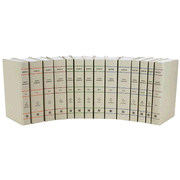
I have ordered the Hendrickson reprint of Church Dogmatics that is available at CBD for only $99 USD(!). Hopefully I can blog my way through this massive series and move on to von Balthasar. As much as possible, I will try to follow the advice of WTM but we'll see how that goes.
I'd still like to see what the covers will look like, but I can't complain about getting CD for $100. Just please don't be ugly, CD, please.
Subscribe to:
Posts (Atom)