Showing posts with label Book Review. Show all posts

Wednesday, August 4, 2010

Thoughts on "Genesis"

Yesterday marked the official end of my reading of Brueggemann's commentary and the listening of lectures aforementioned. I have to admit that I did not read as I said I would and thus instead of taking one month to finish the book Genesis it instead took me three months to finish! However, I am not disappointed as I have learned much.

Firstly, I am glad I opted for a theological commentary over an exegetical for my first take at reading Genesis seriously. I cannot begin to imagine reading footnote after footnote about this particular word and this particular source and the dating the of the book of Genesis. Secondly, I am glad I did not choose a author who would try to convince of an early dating for Genesis or the historical-scientific proofs for a six day creation. I honestly didn't know where Brueggemann stood on such issues, but I was prepared to disagree with him.

It may seem obvious to those who studied Genesis in detail or who had more than a cursory reading when trying desperately to finish reading the Bible in a year, but to those of us finally coming into our studies, the names of each of these books is so important to how one studies them. As Brueggemann points out, Genesis is about the genesis of a world and a family. It is about giving a history for a people in exile. That being said, Brueggemann does get into some historical-critical discussions, but these are never the focus of his writing. He'll often mention sources that we are familiar with like J, E and P but this is usually in passing as if the reader already assumes such sources.

Genesis, according to Brueggemann, can be taken into two halves: the cosmological genesis and the anthropological genesis. The latter genesis can then be broken into four sections: the Abraham, Isaac, Jacob and Joseph cycles. Chief among them is the promise of Abraham which pervades the three remaining cycles is the also that which propels the other cycles into the book of Exodus. Brueggemann argues that we must follow the title Genesis even along to the end which is really not an ending, but really is a beginning that takes us to the Exodus story.

It was interesting to read a theological-homiletical commentary while listening to lectures given from a literary perspective. I have to admit that some of the comments made by Gary Rendsberg seem a bit far-fetched as times, but reading some of the comments that Brueggemann will make that either confirm or hint towards those comments made it easier to hear those things.

Brueggemann's writing style is clearly homiletical as he often gives cross-reference to the gospels or Paul, and often makes connection between the ancient communities of Genesis and how these should or shouldn't shape the Christian communities of the present. Certainly this is not a commentary that should be used on its own for research or scholarly purposes, but it is certainly a beginning place for theological interpretation of Scripture.

Friday, July 16, 2010

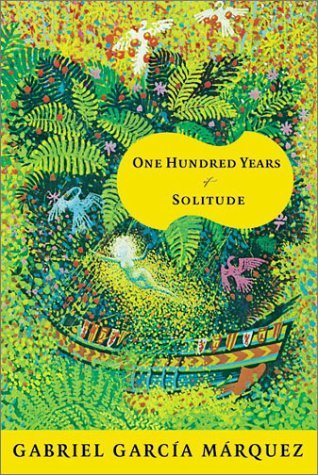
Thoughts on "One Hundred Years of Solitude"


I wish many things, but as I came to the end of One Hundred Years of Solitude I wished that my Spanish was better than currently. There are certain things missed in translations, as most people will admit, that cannot fully be brought over from one language to the another and mean the same thing. Everything inside of me now desires to read Marquez in the original Spanish.

Marquez writes a story about a family that comes upon a certain place and founds a city, Macando. Written in mythic language, the reader finds themselves wrapped up in a world where women live beyond the lifespan of generations of children; where gypsies visit the town and share the secrets of foreign lands; and where the lines of sexuality between brothers and sisters are blurred. This is the land of Macando, this is the family of Buendia.

Without going into much detail on my part, Marquez writes of the Buendia family as any other family and this is what makes them special. It is not they are particularly good at doing something, or that they have become rich by doing something else and therefore need a TV show. What makes them interesting is the fact that they exist in this time in this place. They are because they are.

It is by their names that the Buendia family exists into eternity because it is by their name that they continue to live on the past in the present repeating the events and the characteristics of their patrilineage even without wanting to. Time, then, is nothing more than an idea that shapes the world around us; we do not control it. It could have been said that we shape the world, but in this story we see that we fall into the same footsteps as our parents and their parents before them into timelessness where our great-great-great grandmother grows old with us, goes blind but still sees; where plants and wildlife constantly takeover homes only to be pushed back, only to grow back again; a cycle of timelessness. There is nothing strange about this, though, and we live in this reality that truly nothing is changed while yet everything changes on a daily basis. The paradox of time is what Marquez tries to get at with this timelessness in One Hundred Years.

In some sense it can also be hopelessness, as one pleads for not one other child to be named after their father there is no escaping time. The same mistakes will be made and the same characteristics will be passed on until the end of time and until a whirlwind comes to begin to process anew in the same place with the same people.

Thursday, July 15, 2010

Thoughts on "The Politics of Jesus"

As I finished my undergraduate studies and looked forward to graduate (and looked hopefully to post-graduate studies), I realized how under prepared for academia I was (am). As I said before, I took it upon myself to prepare for graduate school by reading essential works for my field of interest (pneumatology and liberation theology) and began with Amos Yong's The Spirit Poured Out on All Flesh (for a review, see here). Since finishing with Yong I moved onto Yoder's classic Politics of Jesus. Here, I offer some thoughts on Yoder's argument and text.

What Yoder wants to do is show how Jesus is the example for New Testament (NT) ethics and therefore the Christian ethos. "I will attempt to sketch an understanding of Jesus and his ministry of which it might be said that such a Jesus would be of direct significance for social ethics" (p. 11). He argues against the understanding of Jesus's ethical teaching as either temporary (p. 5), too pastoral , too personal, too spiritual (p. 6), not practical or as not concerned with it at all (p. 7).

On the back-cover, there is a quote by Stanley Hauerwas that reads as follows: "I am convinced that when Christians look back on this century of theology in America, The Politics of Jesus will be seen as a new beginning." Indeed. Yoder challenged many of us. His argumentation chapters like "God Will Fight For Us" (ch. 4) can be wanting and not fully engaged with a theological interpretation of scripture as it seems him goal. This should not detract from his basic argument that ancient people had an understanding of a God who intervenes on their behalf.

Yoder does hit his stride in places like chapter ten ("Let Every Soul Be Subject") and eleven ("Justification by Grace through Faith"). In chapter ten, we see Yoder the Exegete. Moving carefully over the letter to the Romans (rightly defined as an ecclesiological letter) and especially over the thirteenth chapter. He overturns common assumptions about what is meant by "the sword" and recognition of power. This chapter is truly a must read for those interested in political theology. In chapter eleven, we see a Yoder of the New Perspective. The first edition of this text comes five years before Sanders's landmark text Paul and Palestinian Judaism. Here he argues that the "fundamental issue was that of the social form of the church" (p. 216). Paul was not, Yoder says, "preoccupied with his guilt and seeking the assurance of a gracious God; he was rather robust of conscience and untroubled about whether God was gracious or not" (p. 215). He speaks more to the point about Gentile inclusion in the proceeding paragraphs and argues quite convincingly.

John Howard Yoder weighs heavy because of the way political systems have entrenched themselves in the lives of Christians. Politics and governmental systems have long been held to be the sword of God distributing wrath and justice alike and have been found to have biblical and theological justification for the most heinous of crimes imaginable. Here we have a John the Baptist, calling a people to repent and be baptized (perhaps rebaptized in the case of Yoder). Jesus then is to "have a clue to which kinds of causation, which kinds of community-building, which kinds of conflict management, go with the grain of the cosmos, of which we know, as Caesar does not, that Jesus is both the Word...and the Lord" (p. 246).